

 About
 Game Servers
 Blogs
 Past works
 Publications
 Toy Train
 My Tests
 Useful Resources
 Digital Asset
 Knowledge Base
Blog
May 03 2025
Paranoia OS
检查至 Oct/11/2026 idea更新:
Idea update reviewed through Oct/11/2026:
由于已有Graphene OS已经实现了大部分功能,尝试去做一下空缺或移植的分析。
Since GrapheneOS already implements much of the proposed functionality, this update examines the remaining gaps and the feasibility of porting existing features.
1. Paranoia OS 总体蓝图与空缺 / Overall Blueprint and Gaps
总体方向。 这里的“大部分功能”主要指通讯录与媒体访问控制,不代表合成画像或消除数据采集动机已经实现。建议将 Paranoia OS 定位为现有安全系统上的“按应用个人数据视图”:让应用只看到用户选择的空白、有限真实或替代数据。GrapheneOS 使用指南
Overall direction. “Much of the functionality” primarily refers to contact and media access controls, not synthetic identities or the elimination of data-collection incentives. Paranoia OS could become a per-app personal-data layer on an established secure system, exposing only empty, selectively real, or substitute data chosen by the user. GrapheneOS usage guide
功能空缺。 候选方向是可持续读写的虚拟通讯录与日历、按应用的位置替代策略,以及统一的预览、授权和重置界面。虚拟数据应前后一致,并与真实数据隔离;能用空白或有限授权解决的问题,不必生成假数据。
Functional gaps. Candidate extensions include persistent, writable virtual contacts and calendars, per-app location substitution, and a unified interface for previewing, granting and resetting access. Virtual data should remain consistent and isolated from real data. Synthetic records are unnecessary when empty data or selective access already works.
安全边界空缺。 需要明确保护哪些数据、对手能观察什么,不承诺“OS 层实现就无法识别”。Android 的主要隔离边界是应用;据此不能假定,把真实数据交给同一应用后,还能仅靠权限开关区分正常功能与画像用途。Android 应用沙箱
Security-model gaps. Specify the protected data and the adversary's visibility; OS-level implementation does not establish undetectability. Android primarily isolates applications. Consequently, permission switches alone should not be assumed to separate legitimate use from profiling once the same app receives real data. Android application sandbox
效果验证空缺。 “减少真实数据暴露”与“让企业放弃采集”应分开验证。需要测试假数据被过滤或与其他信号交叉分析后,保护是否仍有效。个人保护应在单个用户使用时就成立;行业级经济影响保留为研究假设。
Evidence gaps. Reduced exposure and reduced commercial collection incentives require separate validation. Test whether protection survives filtering of synthetic data and correlation with other signals. Individual protection should work for a single user; industry-wide economic effects remain a research hypothesis.
运营空缺。 尚需确定设备支持、安装迁移、安全更新和维护资金。建议取消“必须闭源”的前提,以可审查的隔离机制建立信任;可探索捐赠、研究资助和付费部署维护,但不能视为已有收入。GrapheneOS 的捐赠模式可作参考。GrapheneOS 资金支持
Operational gaps. Device support, installation, migration, security updates and funding remain undefined. Drop the closed-source requirement and build trust through auditable isolation. Donations, research grants and paid deployment or maintenance are options to validate, not established revenue. GrapheneOS provides a donation-funded reference. GrapheneOS funding
2. 与 GrapheneOS 的简要对比 / Brief Comparison with GrapheneOS
理念。 两者都希望在保留应用可用性的同时限制数据暴露。GrapheneOS 是开源的隐私与安全系统,重点在沙箱、权限和漏洞利用缓解;Paranoia OS 原案进一步希望通过假数据干扰画像及采集动机。区别是目标范围,而不是简单的“拒绝权限”对“提供假数据”。GrapheneOS 项目说明
Philosophy. Both seek to limit exposure while preserving app usability. GrapheneOS is an open-source privacy and security OS focused on sandboxing, permissions and exploit mitigations. Paranoia OS additionally proposes synthetic data to disrupt profiling and collection incentives. The distinction is scope, not simply permission denial versus fake data. About GrapheneOS
通讯录:核心机制已重合。 Contact Scopes 可让应用认为已有通讯录权限,默认不给联系人,也可只开放选定联系人或字段。原案新增的部分是合成联系人,而非“假装授权”本身。Contact Scopes
Contacts: the core mechanism already overlaps. Contact Scopes makes apps behave as though contact permission is granted while providing no contacts by default, or only selected contacts or fields. The proposed addition is synthetic contacts, not the apparent permission grant itself. Contact Scopes
媒体与系统服务:已有可复用基础。 Storage Scopes 默认让应用访问自己创建的文件,并可额外开放选定文件或目录,接近原案的单向媒体访问。Sandboxed Google Play 也已使 Google Play 可作为无特殊权限的普通应用运行。GrapheneOS 功能说明
Media and system services: reusable foundations exist. Storage Scopes permits access to an app's own files and optionally selected files or directories, closely matching the proposed media-access model. Sandboxed Google Play also allows Google Play to run as ordinary apps without special privileges. GrapheneOS features
位置:有规划,不能写成已实现。 GrapheneOS 官方已提出按应用实例提供 Location Scopes;截至本次检查,功能页与发布记录未确认交付。因此它是可协作的候选方向,而非完全无人涉及的空白。官方规划 · 功能页 · 发布记录
Location: planned, not confirmed as shipped. GrapheneOS has announced per-app-instance Location Scopes. Its feature documentation and release notes did not confirm delivery at this review. This is a potential collaboration area, not an entirely unexplored feature. Official plan · Features · Releases
3. 开发与移植方向 / Development and Porting Direction
优先扩展,谨慎移植。 建议先在 GrapheneOS 上验证新增能力,再评估向其他 AOSP 系统移植。工程评估应覆盖权限框架、系统数据服务和设置界面的依赖,不能预设为复制一个 APK;移植若干功能也不等于获得 GrapheneOS 的整体安全性。GrapheneOS 源码 · Android 应用沙箱
Extend first; evaluate ports carefully. Validate additions on GrapheneOS before considering other AOSP systems. Assess dependencies across permissions, system data services and settings rather than assuming a single APK can be copied. Porting individual features does not reproduce GrapheneOS's overall security. GrapheneOS source · Android application sandbox
最小原型。 先选择虚拟日历或位置策略之一,对比拒绝权限、现有有限授权与新方案,测量真实数据泄漏、任务完成率、画像推断能力、耗电和维护成本。只有证明新增收益,才扩大范围;暂不纳入跨用户账户互换,以免引入凭证共享与活动归属混乱。
Minimum prototype. Start with either a virtual calendar or a location policy. Compare denial, existing selective access and the new approach against data leakage, task completion, profiling accuracy, battery use and maintenance cost. Expand only after demonstrating added value. Exclude cross-user account swapping initially to avoid credential sharing and ambiguous activity attribution.
结论:有开发空间,但优先做可验证的隐私扩展与移植评估,不急于另建 OS,也不把“消灭数据采集动机”作为产品承诺。
Conclusion: there is development space, primarily in verifiable privacy extensions and porting evaluation—not an immediate need for another OS or a promise to eliminate data-collection incentives.
Relevance of data poisoning
With the modern data practice whether companies want to target users with ads (As quote from Triston Harris "The business model of google is to get everyone to buy 0.3 pairs of shoes"), or government wanting to crush descent and have an atomized society (authoritarian/autocratic societies actually are easier to govern as you can just solve the people who raise the issues instead of the issues).
Incentive structure
While places like EU focuses on using laws to ban certain practice, as we see in US the political climate can flip on a dime over night. A truly widely adopted system that will remove companies incentive to collect your data.
Core idea of removing incentive
If the data collected is useless to the data collector, it will remove company's incentive to collect and analyze such data.
Design requirement of Paranoia OS
OS level modification (can be a deeply customized distribution of Linux/Android which has some of the core packages modified)
- For wider access, it needs to be free, but can not be opensource (How to make it financially sustainable?)
- Reason it needs not to be open source is that if it's open source, the companies will very fast implement countermeasures. Unless the implementation can be on a layer that application software (even factory installed software like google/apple pre-install which we assume will have more system level privilege) won't be able to recognize API call (I don't think it's achievable, but I'll be happy if I'm wrong)
- Enabling condition
- Modern data plans are cheaper with more GBs, and most people have access to WiFi at most of the time.
- Core Idea
- Account traffic sharing and scrambling for non essential data (eg, not identity/financial related info), this is less feasible, as this targets more of a core function from Apple/Google, that the company will probably just change TOS or just modify the software to ban this.
- Explanation, when a request of google map location is sent, the all users world wide will randomly send location update/request through eathother's account. In this way, knowing a certain account's location wouldn't yield any analytic value to remove their incentive to collect this data.
- A more feasible idea to disincentivize application level apps to collect data.
- A lot of modern apps seems to request a lot of unnecessary permission to tap into user's media/calendars/contact lists.
- Modern Mobile OS has Allow/Allow one time/Deny options. however a lot of apps will just quit if you deny the access. So for convenience, most users will just allow to use the function, basically caving to company's demand.
- Other than the existing options, add a fourth option like "spoof" or "scramble", that it give app the information, but instead of streaming in real data, it will stream fake data. It's implemented in an OS level so the app will have no way to know.
- Eg 1. when contact list permission is asked, it will give the contact of randomly generated (prelim idea, as companies may be able to detect this trick) contacts, allowing the user to use the app while not showing realife personal contact to the company.
- Eg 2. when location is asked, instead of feeding real location, a random location is fed to the app. This might need a more nuanced setting, as sometime it might be ok if you appear to be in another country, but other times, giving proximate location probably make sense, but system can prevent the precise location being given allowing the company to know your pattern of life.
- One way access: some time like video/image app will legitimately need to save video/image, there should be an option to let them access the media folder where the app can only see the files the app created. (This will need to implement new feature to the FS in OS cores to make app full can't distinguish that it only have partial access)
- Account traffic sharing and scrambling for non essential data (eg, not identity/financial related info), this is less feasible, as this targets more of a core function from Apple/Google, that the company will probably just change TOS or just modify the software to ban this.
Potential is still dim
While the hypothesis is when data are scrambled/spoofed, it poisons the data enough where the company will not be able to generate meaningful/useful analytics, it will disincentivize companies to even implement data collection mechanism that ultimately will benefit all users. The effect won't be significant enough if it doesn't hit a critical mass of users. And this kind of software usually exist in the form of custom ROM which is only accessible to very few tech guru who know how to JTAG/flash a phone or root the android.
But it doesn't mean if a dev community is interested in this idea, they can't start putting something together to test a proof of concept.
Mar 26 2025
Antinatalism Revisited
Years has past since I noticed I'm not the only weirdo who think about whether sentient life is worth STARTGING.
A revisit of problem of asymmetry.
| Condition | No Sentient Life | Sentient Life |
|---|---|---|
| Results | There's no suffering | There's suffering |
| There's no good | There's good |
While I do not fully agree with Prof. David Benatar's asymmetry, to me it's symmetrical however the result is at least semi-plausible.
| Condition | No Sentient Life | Sentient Life |
|---|---|---|
| Results | No one is relieved of suffering, it's not good (Benatar say it's good, because there's no suffering) | There's suffering |
| No one is deprived of good, it's not bad (This is still in agreement with Benatar) | There's good |
Discussion:
- On the good/bad macro-asymmetry
- Benatar claims not creating suffering is good, good for who?
- To the person yet to be/not to be born
- A none-existing entity is not relieved of suffering for not born
- If the claim that lack of suffering is good, then you have to say lack of good is bad, Benatar's rebuttal to the latter is "people make the mistake of thinking you exist and deprived of good", using the same logic, you have to say none-exist entity is not relieved of suffering for not existing.
- To the whole collection
- If the claim that preventing birth reduces collective suffering, then you have to be consistent in saying that collectively preventing birth reduces collective good.
- To person alive
- There's an argument to be made that living person needs new born to grow up to be in the labour force to take care of.
- This is the worst argument for pro-natalism as those born, in a day will certainly needs care for more people, get sick, have accidents and certainly die.
- The "living need more new people, and those new people will need even more new people", is definition of a Ponzi Scheme.
- To the person yet to be/not to be born
- Benatar claims not creating suffering is good, good for who?
- Micro -asymmetry seems to still stands
- Doing nothing - the most neutral point is negative because there's something called "boredom"
- We have evolved in a hostile environment that evolution keeps us always alert. Just like auto-immune disease, if the immune system do not find something external to attack, it start attacking the host itself. The same evolution trait that keeps us alert to predators gives us anxiety/depression in the modern day where no such threats are present.
- Improved living condition does not always lead to improved happiness, or at least only does it in a very diminished way
- In ancient days, it takes us months to travel, messages takes weeks to arrive, food-prep, chores like cleaning and washing takes up more than half of time awake.
- Modern days automation and division of labour uses economy of scale to relieve us from such chores, however did we become less busy?
- Good diminishes but Suffering persist
- The greatest pain is far greater than the greatest pleasure.
- Pleasure is diminishing (an extreme example is drug, however people don't notice other things does it as well)
- Just imaging your favourate food now, have it for a week, do you still like it? Have it a month, do you still like it?
- All the good we seek is actually escaping from suffering
- We keep ourself busy because boredom is suffering
- Eating relief of suffering of hunger, however try continue eating, it doesn't give you good, you just don't feel well again
- We have to rely on drugs to avoid suffering - scandinavian countries have the highest happiness, correlates to the treatment they receive including drugs that alters the state of the mind.
- Is it sufficient condition to start a sentient life if the good and suffering is 50-50?
- Many thinks if there's a good chance to break even, then we should start the life.
- However:
- Would you go on a plane if it has a 5% chance of crashing?
- Some time even for relieving suffering, would you be willing to take a surgery with a 80% chance of fixing your problem, but 15% chance of dying on the operating table?
- I don't think there's a definite answer assigned to it, different people have different answered but one thing is sure, it's not 50-50.
- The stake is very high for creating new sentient life.
- The case for adopting:
- Those who are already born, will have to suffer one way or another regardless
- Therefore adopting did not become the source of the suffering.
- The stake is much lower as per comparison point: the condition of the adopted child just need to be better than whatever adoption center (easy), abusive parents(even easier) or full abandonment(even much easier) for adoption to be doing net good.
- Those who are already born, will have to suffer one way or another regardless
- Doing nothing - the most neutral point is negative because there's something called "boredom"
- State of the world argument against bringing new sentient being into life
- The ideology of the people in power
- They worry about "population collapse" purely in the sense that it translates to one drop in their wealth concentration
- The google's whole business model is to get everyone to buy 0.3 pairs of shoes.
- The contradiction:
- They do not want to materially improve normal people's living condition
- They hate "Free handouts" and want people to "pull themselves up by the bootstrap"
- They are automating away all the jobs
- They worry about "population collapse" purely in the sense that it translates to one drop in their wealth concentration
- The Survivor's bias and Optimism Bias
- For every successful people, there are probably hundreds of people living mediocre boring life, and tens of thousands living struggling.
- Most of them aren't lazy, they work hard and have nothing to show for it. They are not the ones getting Forbes interviews or TED talks, so people just don't think they exist.
- Thus the "Optimism Bias", people think their children could become one of the lucky ones (technically true), basically buying into the Survivor's bias narrative.
- Some people who are born into wealth realize that, it's actually the ones who "worked from the bottom" who usually doesn't understand the luck component to it. Like the actor for Tyrion Lannister - Peter Dinklage, basically the narrative become "I come from poor family, I worked hard, I succeeded, therefore if people don't succeed, it's their own problem there's no excuse". But it is understandable for successful people to grow a huge EGO, and people don't realize the luck element and how important it is as per famous monopoly experiment
- Thus the "Optimism Bias", people think their children could become one of the lucky ones (technically true), basically buying into the Survivor's bias narrative.
- Success ≠ happiness
- Given that the richest man on earth has to constantly seek validation of other people, even by pretending to be good at video games, success/wealth ≠ happiness.
- However we can't fall into the fallacy of "therefore other side good". Poor/powerless people have all the problem rich/powerful people have plus financial problem and access to option problem. Therefore the probability of being happy is even less than rich or powerful people.
- The authoritarian shift of the world
- It's understandable that people who gets bored of democratic system wants a "Strong leader".
- This is where we see USA Chinafy/Russifying, and China DPRK-ifying.
- Even Europe are start seeing anti-protest laws by forbidding filming the police(eg. France), and de-facto blasphemy laws in the name of security.
- It is understandable as it's an easier way to government if you can solve the people who raise the issue rather than the issue.
- However, in the long run, the suffering of the world will increase for most of the people.
- Therefore not having children is a statistically sound choice, if the goal is to reduce suffering to good ratio (at least in the foreseeable future).
- The ideology of the people in power
Oct 25 2023
Can you quantum test prayer
- Overview
The push back people use when people try to setup experiment(Like The Harvard Prayer Experiment) to test the validity of various claims regarding prayer is usually "You can not test god". However this pushback leads to several paradoxes.- Paradoxes
- Every testimony is a test
I'm quite interested in what religious activities people do and why people do them, so I have attended a lot of church sessions where there are people give testimony to justify conversion to (usually Christianity). The testimony usually go something like after start believe god and praying, they either get good jobs, or go through hardships of life, etc. It's basically equivalent of saying "I tested praying, it worked". So unless people keep the information private between them and god, every testimony is a test. - Condition that invalidate all prayer
If testing make prayer not work and therefore couldn't be tested, people can just setup an experiment that will track at least a subset of population's prayer result. If the "you can not test god" is true, the setup of the experiment will invalidate all the prayer that person does which seems to be like a "bug" of a system. - Similar to quantum state reveal
Post modernist likes to attribute the "mysteriousness" of how prayer work to the spookiness of quantum physics. Although most of it is just normies like you and me misunderstanding the spookiness of quantum physics, there is actually some merit in this comparison. When a photon/electron is observed, it "solidifies" the state of the "decision" the photon/electron made, which made it analyzable using statistic method. Similarly if we setup experiment track people's prayer which already have result, as a result, even if those participant agreed to be in the experiment, their prayer was sincere and not a test at the moment of the prayer therefore were all valid prayers for statistical analysis purpose.
- Every testimony is a test
- Paradoxes
- Digress
- To establish why quantum test would be the only test that's worth running on prayer
- People usually pray for cancer for remission but not amputees to regrow because there's claim: prayer only work on mysterious properties rather than seemingly deterministic properties.
- Similarly prayer experiment could be run on Random number generators, however most random number generators on computers are Pseudo Random which means it's deterministic, that is probably not mysterious enough.
- To establish why quantum test would be the only test that's worth running on prayer
- So here is the experiment
- Problems to address
- The prayers have to be sincere and not knowing it's an experiment
- (Only some claims) Cause have to be noble, and can't be "I want a car" or something like that, although it's not a universal concern, still worth to be addressed
- Process also have to be blind for researcher to reduce the cognitive bias.
- To have comparison point, we need to pick something that at neutral state has a statistical 50/50 chance. QRNG(Quantum Random Number Generator)'s neutral state is known, which is if do it enough time, it should be 50/50. (Note: unlike pseudo-random number generator which is deterministic and seems can't be altered by prayer, quantum random number generator is a true randomness, therefore if the religious hypothesis is true can alter the statistical result)
- Experiment design: The QRNG donation challenge
- Setup a youtube/twitch/etc. live stream of QRNG(quantum random number generator) generating bits, setup a period for each session to make the donation.
- The stream also covers a conditions that for every excess "1s / 0s"(decided but not revealed, but fully recorded and verified by a 3rd party that agrees to NDA to ensure no cheating) donate 1$ to foodbank. The viewer do not know the condition but god surely should know, with prayers to donate more, god would know which number to increase.
- When time runs out, reveal the condition and the result in front of the livestream and make the donation.
- Run several rounds to ensure is not just random errors leading to prayer "works" or "not work".
- Hypothesis
- Because most people will be praying for more donation to foodbank (unless you believe more religious people are evil than benign), at each experiment session, there should be (at least) positive amount of donation.
- The amount also should be quite large, as "solve world hunger" is a common prayer so people does not need to be watching the stream to be praying for that. Therefore should sway the QRNG in the direction of pre-defined goal saved on a hidden medium verified by a 3rd party with no conflict of interest.
- Even if you argue that the people watching the stream will know that you are testing prayer, all those who are praying to end world hunger who's not watching the stream does not know it's a test and are hence sincere.
- The goal is not selfish, the goal is noble so according to a majority of religious explanations, the prayer should be answered.
- Problems to address
Oct 24 2023
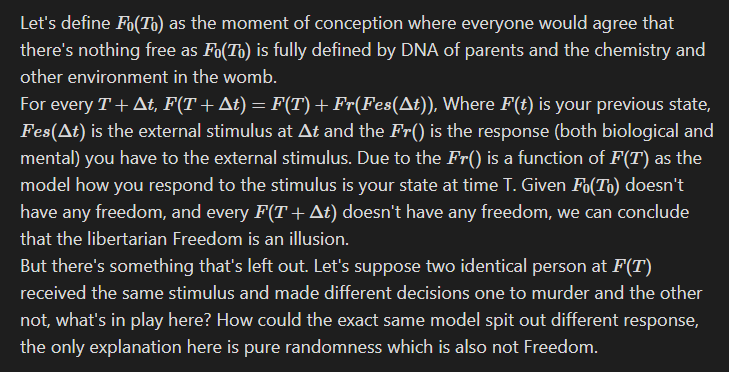
Libertarian Free Will is Still an Incoherent Concept
Update Oct/11/2026, a more comprehensive analysis
初始条件、状态演化与自由意志:一个条件性的形式化论证 / Initial Conditions, State Evolution, and Free Will: A Conditional Formal Argument
1. 论题与适用范围 / Thesis and Scope
本文尝试形式化以下直觉:一个个体并未选择其最初的构成条件;此后的选择能力又是在这些条件、后续经历和内部过程的基础上形成的。因此,即使行动确实由这个个体作出,该个体也未必是其行动能力与意愿的终极自主来源。这里需要区分数学模型内部可以证明的结论,以及从模型走向自由意志判断时必须加入的哲学前提。
This essay formalizes the following intuition: an individual does not choose the conditions from which they initially develop, while their subsequent capacity for choice emerges through those conditions, later experiences, and internal processes. Consequently, even when an action is genuinely performed by the individual, the individual may not be the ultimate self-originating source of the capacities and motivations producing it. We must distinguish conclusions demonstrable within a mathematical model from the philosophical premises needed to interpret those conclusions as claims about free will.
本文用 \(F_U\) 表示一种较强的“终极来源自由”:行动者不仅依照自己的意愿行动,而且对构成相关意愿与选择机制的根源具有终极自主性。这与 Strawson(1994)关于终极道德责任的“基本论证”相近,但本文不把自由意志和道德责任直接视为同一个概念。
We use \(F_U\) to denote a strong conception of ultimate-source freedom: the agent not only acts through their own will but also possesses ultimate authorship over the origins of the relevant motivations and mechanisms of choice. This resembles Strawson’s (1994) Basic Argument concerning ultimate moral responsibility, although free will and moral responsibility are not treated here as identical concepts.
这种定义不能代表所有自由意志理论。相容论允许某些形式的自由与决定论共存;哲学上的自由意志论(libertarianism)则主张存在某种与决定论不相容的自由,但不同版本并不都要求人预先选择自己的全部初始条件。因此,本文首先考察强终极来源自由,而不是通过定义直接否定所有意义上的自主性(Frankfurt, 1971; Kane, 2009)。
This definition does not represent every theory of free will. Compatibilism allows certain forms of freedom to coexist with determinism. Philosophical libertarianism maintains that some freedom exists that is incompatible with determinism, but its different versions do not all require people to have previously chosen their entire initial conditions. The primary target here is therefore strong ultimate-source freedom, rather than autonomy in every possible sense (Frankfurt, 1971; Kane, 2009).
2. 状态、输入与演化 / States, Inputs, and Evolution
选择一个固定的时间步长 Δt,并把时间表示为以下序列。这里使用离散时间只是为了简化记号,不意味着物理时间本身必然是离散的。
Choose a fixed time step Δt and represent time by the following sequence. Discrete time is used to simplify the notation; it does not imply that physical time itself must be discrete.
令 xₙ 表示个体在 tₙ 时刻的完整相关内部状态,sₙ 表示该次更新所接收的外部输入,aₙ 表示该次产生的行动或决策。这里的“完整相关状态”不是仅指当事人能报告的记忆,而是模型中足以承载所有与后续演化有关的内部信息的状态,包括记忆、倾向、正在进行的内部活动,以及可随学习改变的参数。状态空间建模的基本思路,是用当前状态承载过去对未来仍然有影响的信息(Åström & Murray, 2008)。
Let xₙ denote the individual’s complete relevant internal state at tₙ, sₙ the external input received for that update, and aₙ the resulting action or decision. A complete relevant state is not merely the person’s reportable memory. It contains all internal information relevant to subsequent evolution within the model, including memories, dispositions, ongoing internal activity, and parameters that may change through learning. The basic idea of state-space modeling is to represent, in the present state, the information from the past that remains relevant to the future (Åström & Murray, 2008).
可以约定 t₀ = 0 为受精时刻,但这只是选择发展过程的建模起点,并不假定受精时已经存在意识。本文采用的起源前提是:后来成为有意识主体的个体,没有预先选择 x₀,也没有预先选择支配其发展的基本规律。x₀ 不应被简化为父母 DNA 的唯一函数;尚未发生的胚胎期环境影响,则应进入后续输入或环境演化,而不是全部塞进初始状态。
We may conventionally set t₀ = 0 at conception, but this merely selects a starting point for modeling development; it does not assume consciousness exists at conception. The origin premise is that the individual who later becomes a conscious agent did not previously choose x₀ or the fundamental laws governing their development. Nor should x₀ be reduced to a function of parental DNA alone. Prenatal environmental influences that have not yet occurred belong in subsequent inputs or environmental evolution, rather than being indiscriminately placed in the initial state.
在决定性模型中,状态更新与行动生成可以分别写成下式。Φ 是状态转移函数,G 是行动生成函数;在相关状态与输入完全给定后,它们分别给出唯一的下一状态和行动。
In a deterministic model, state updating and action generation can be written separately as follows. Φ is the state-transition function, and G is the action-generation function. Once the relevant state and input are completely specified, they return a unique next state and action, respectively.
这种写法比“旧状态加上反应”更一般,因为抽象状态之间未必定义了加法。它也不意味着个体只是被动地响应刺激:即使外部输入不变,Φ 仍可以描述内部思考、身体活动和自我调整。把相关信息全部纳入 xₙ,是模型的完整性假设,而不是已经由神经科学证明的事实。
This formulation is more general than adding a response to the previous state, because addition need not be defined between abstract states. It also does not imply that the individual merely reacts passively to stimulation: even with unchanged external input, Φ may describe internal deliberation, bodily activity, and self-adjustment. Including all relevant information in xₙ is a completeness assumption of the model, not an established neuroscientific finding.
过去经历应当用有时间顺序的输入序列表示,而不是无序集合。令下式中的粗体 s 表示输入历史;反复代入状态更新式,可以得到状态和行动对初始条件及输入历史的依赖。
Past experience should be represented by an ordered sequence of inputs rather than an unordered set. Let the boldface s below denote the input history. Repeated substitution into the update equation yields the dependence of states and actions on initial conditions and input history.
这里 Φₙ 和 Ψₙ 是通过迭代与复合得到的函数。最后两式可以通过数学归纳法证明:若第 n 步状态已经由初始状态和此前输入确定,再应用一次 Φ,第 n + 1 步也具有同样的依赖结构。不过,这证明的是函数依赖关系,尚未证明任何一种自由意志不存在。
Here Φₙ and Ψₙ are functions obtained through iteration and composition. The last two equations follow by mathematical induction: if the state at step n is already determined by the initial state and preceding inputs, one further application of Φ gives the same dependency structure at step n + 1. This establishes functional dependence, however, not yet the nonexistence of any conception of free will.
3. 个体会影响自己的输入 / Agents Can Influence Their Own Inputs
“所有外界刺激都不是由个体决定的”作为字面上的因果命题过强。在模型中,一个人可以通过走进另一个房间、寻找信息或改变注意方向,影响随后接收到的输入。更合适的处理方式是加入个体与环境之间的反馈:环境影响个体,个体的行动又改变环境。这种双向作用正是反馈建模的基本结构(Åström & Murray, 2008)。
The literal causal claim that no external stimulus is determined by the individual is too strong. Within the model, a person may influence later inputs by entering another room, seeking information, or redirecting attention. A better formulation includes feedback between agent and environment: the environment influences the individual, while the individual’s actions modify the environment. This bidirectional interaction is the basic structure of feedback modeling (Åström & Murray, 2008).
令 eₙ 表示相关环境状态,H 表示输入形成过程,Γ 表示环境演化。把个体状态与环境状态合并为 zₙ 后,在决定性且因果完整的模型中,可以得到一个联合演化函数。这里的环境必须包含相关外部影响;尚未纳入的影响不能被默认为不存在。
Let eₙ denote the relevant environmental state, H the process generating the agent’s input, and Γ environmental evolution. Combining agent and environment into zₙ gives a joint evolution function in a deterministic, causally complete model. The environment must include relevant external influences; influences omitted from the model cannot simply be assumed not to exist.
因此,固定演化规律后,第 n 步行动可以写成下式,其中 𝒯ⁿ 表示把联合转移函数重复应用 n 次。个体选择未来的环境,并不破坏这个表达式;这种选择本身已经包含在联合动力学中。需要区分的是“个体参与形成自己的经历”与“个体终极地创造了整个因果起点”。
Consequently, with the evolution laws fixed, the action at step n can be written as follows, where 𝒯ⁿ denotes n repeated applications of the joint transition function. An individual’s selection of future environments does not invalidate this expression; that selection is already included in the joint dynamics. The relevant distinction is between participating in the formation of one’s experiences and ultimately creating the entire causal starting point.
4. 完全相同个体的思想实验 / The Identical-Agent Thought Experiment
设想两个副本,它们具有完全相同的相关初始状态、输入历史和演化规律。这里的“完全相同”不是外表相同、记忆相同或同卵双胞胎,而是思想实验所假定的全部相关状态都相同。在决定性模型中,它们必然经历相同的状态序列并产生相同的行动。
Imagine two copies with exactly the same relevant initial states, input histories, and evolution laws. “Exactly the same” does not mean merely similar appearance, identical reported memories, or identical twins. It means identity of every relevant state variable stipulated by the thought experiment. In the deterministic model, the copies must follow the same state sequence and produce the same actions.
这个结论只是同一个单值函数对相同参数返回相同结果。如果两个副本在相同情境下作出不同决定,那么至少一个前提需要修改:状态或输入并不真正相同,演化规律并不相同,模型遗漏了相关变量,或者演化过程不是决定性的。仅凭不同结果,不能直接断言已经发现了自由意志,也不能直接断言差异必然来自量子随机性。
This conclusion follows from the fact that the same single-valued function returns the same result for the same arguments. If the copies make different decisions in the same situation, at least one premise requires revision: their states or inputs are not truly identical, their evolution laws differ, relevant variables have been omitted, or the evolution is nondeterministic. Different outcomes alone establish neither the discovery of free will nor a specifically quantum source of the difference.
5. 随机性如何进入模型 / Introducing Randomness
若允许非决定性,可以引入随机变量 ξₙ,将模型扩展如下。ξₙ 表示该步的随机实现;它可以是一个向量,也不必在不同时间之间相互独立。写出这个符号并不证明现实中存在基本随机性,更不证明其来源一定是量子过程;它首先只是模型中的一种表示方式。
If nondeterminism is allowed, introduce a random variable ξₙ and extend the model as follows. ξₙ represents the random realization at that step; it may be a vector and need not be independent across time. Introducing this symbol establishes neither fundamental randomness in reality nor an exclusively quantum origin. It is initially a modeling representation.
这时,相同状态与输入可以对应相同的结果概率分布,却不必对应相同的实际结果。例如,令 aₙ = 1 表示实施某项行为,aₙ = 0 表示不实施;给定 xₙ 和 sₙ 后,可以用一次均匀分布抽样表示该次结果。下面的 𝟙 是指示函数:括号内条件成立时取 1,否则取 0。
The same state and input may now correspond to the same probability distribution of outcomes without producing the same realized outcome. For example, let aₙ = 1 represent performing an action and aₙ = 0 not performing it. Conditional on xₙ and sₙ, a uniform draw can represent the realized result. The symbol 𝟙 below is the indicator function: it equals 1 when its condition holds and 0 otherwise.
这个例子不能把整个决定归结为“纯随机”:概率 p 仍然可以依赖个体的理由、目标和判断。能够用随机模型描述一项行动,也不自动意味着该行动没有主体控制。Kane(2009)就主张,某些非决定性的“自我形成行动”可以包含有目的的努力,而不只是与主体无关的抽签。本文若要否定这种行动具有终极来源自由,仍需额外的哲学前提。
This example does not reduce the entire decision to pure randomness: p may still depend on the individual’s reasons, goals, and judgments. Describing an action with a stochastic model does not automatically establish that the action lacks agent control. Kane (2009), for example, argues that certain indeterministic self-forming actions can involve purposive effort rather than a lottery disconnected from the agent. Rejecting ultimate-source freedom in such actions still requires an additional philosophical premise.
6. 量子概率与混沌的区别 / Quantum Probability and Chaos
6.1 量子概率 / Quantum Probability
量子力学中的 Born 规则把量子态与测量结果的概率联系起来。对于归一化纯态 |ψ〉,若按正交归一基 {|k〉} 进行投影测量,结果 k 的概率是相应概率幅的模平方。其中 〈k|ψ〉 表示该量子态在测量基向量 |k〉 上的复数概率幅(IBM, n.d.)。
The Born rule relates a quantum state to probabilities of measurement outcomes. For a normalized pure state |ψ〉, a projective measurement in an orthonormal basis {|k〉} yields outcome k with probability equal to the squared modulus of the corresponding amplitude. Here 〈k|ψ〉 is the complex probability amplitude associated with the measurement basis vector |k〉 (IBM, n.d.).
不过,“理论给出概率”不等于“所有可行解释都承认本体上的随机性”。Bohm(1952)提出的隐变量解释提供了决定性的量子描述。因此,把 ξₙ 解释为根本不可决定的量子随机实现,是一个额外的物理解释立场,而不是仅凭 Born 规则即可推出的结论。
However, a theory assigning probabilities is not equivalent to every viable interpretation accepting ontological randomness. Bohm’s (1952) hidden-variable interpretation provides a deterministic quantum description. Interpreting ξₙ as a fundamentally indeterminate quantum realization is therefore an additional interpretive commitment, not a conclusion supplied by the Born rule alone.
6.2 混沌与微小差异的放大 / Chaos and the Amplification of Small Differences
混沌讨论的是某些决定性动力系统对初始条件的敏感依赖:很小但非零的初始差异,可能经过演化形成明显的轨迹差异。Lorenz(1963)的研究展示了这种决定性的不规则演化。混沌不要求参数数量极多,也不是在完全相同的状态中凭空加入一个随机值。
Chaos concerns sensitive dependence on initial conditions in certain deterministic dynamical systems: small but nonzero initial differences can develop into substantial differences between trajectories. Lorenz’s (1963) work demonstrates such deterministic irregular evolution. Chaos requires neither an enormous number of parameters nor the insertion of a random value into otherwise exactly identical states.
用连续时间作局部说明时,沿不稳定方向的微小扰动常可用下式近似描述。δz(t) 是两条邻近轨迹的状态差,范数表示差异大小,λ > 0 表示相关的正 Lyapunov 指数所描述的指数增长率。这种表达适用于相应的小扰动增长区间,不意味着任意扰动都沿所有方向无限指数增长;有限尺度效应与饱和会限制它的适用性(Mitchell & Gottwald, 2012)。
For a local continuous-time illustration, a small perturbation along an unstable direction can often be approximated by the expression below. δz(t) is the state difference between nearby trajectories, the norm measures its size, and λ > 0 represents the exponential growth rate associated with a positive Lyapunov exponent. This describes an appropriate small-perturbation growth regime, not unlimited exponential growth in every direction; finite-scale effects and saturation limit its applicability (Mitchell & Gottwald, 2012).
关键是:在演化解唯一、规律相同且相关输入相同的决定性模型中,完全相同的初始状态仍然产生相同轨迹。混沌放大差异,但不能从严格为零的差异制造分歧。因此,“两个副本完全相同”与“两个副本其实存在未观测到的微小差异”是两个不同的思想实验(Lorenz, 1963)。
Crucially, in a deterministic model with unique evolution, identical laws, and identical relevant inputs, exactly identical initial states still produce identical trajectories. Chaos amplifies differences but does not manufacture divergence from an exactly zero difference. Consequently, exactly identical copies and copies with unobserved microscopic differences constitute different thought experiments (Lorenz, 1963).
此外,不同初始条件导致不同结果,并不总需要混沌;普通的决定性响应也可以做到这一点。混沌是放大差异的一类动力学机制,而不是一切差异的统称。
Moreover, different initial conditions can produce different outcomes without chaos; ordinary deterministic responses can do so as well. Chaos is one class of dynamical mechanisms that amplify differences, not a synonym for every difference between outcomes.
7. 假说一:终极来源自由不存在 / Hypothesis One: The Absence of Ultimate-Source Freedom
前面的状态方程还不足以推出“没有自由意志”。为了得到针对 \(F_U\) 的结论,需要明确加入以下前提。特别是,不能把“一个函数由其他变量决定”直接翻译成“个体没有控制”。
The preceding state equations do not yet establish the absence of free will. To reach a conclusion about \(F_U\), the following premises must be made explicit. In particular, functional dependence on other variables cannot simply be translated into the absence of agent control.
P₁:因果完整性。 模型已经包含所有与行动产生有关的状态、相互作用和规律;任何额外的非决定性影响也必须在模型中得到表示,而不能另行假定一个未被说明的选择来源。
P₁: Causal completeness. The model includes every state, interaction, and law relevant to the production of action. Any additional nondeterministic influence must also be represented, rather than introducing an unexplained source of choice outside the account.
P₂:起源非自选。 个体没有预先选择其初始条件或基本演化规律;其最初并不具有对这些起点的终极来源控制。
P₂: Unchosen origins. The individual did not previously choose their initial conditions or fundamental evolution laws and initially possesses no ultimate-source control over those starting points.
P₃:决定性传递前提。 一个原本没有终极来源控制的系统,仅通过先前状态所决定的演化,不会因此获得对其整个相关起源的终极自主性。这里否认的是终极来源控制的生成,而不是学习、自我调整或日常控制能力的生成。
P₃: Deterministic transmission premise. A system initially lacking ultimate-source control does not acquire ultimate authorship of its relevant origins merely through evolution determined by preceding states. This denies the generation of ultimate-source control, not the development of learning, self-adjustment, or ordinary control capacities.
P₄:随机性不足前提。 对原本没有终极来源控制的系统,加入并非由它终极控制的随机实现,也不足以赋予这种终极自主性。这个前提不仅涉及“纯抽签”,也涉及既有动机与随机过程的组合;它是一项需要辩护的哲学主张,而不是随机变量定义中的数学事实。
P₄: Insufficiency-of-randomness premise. Adding random realizations that are not ultimately controlled by a system initially lacking ultimate-source control is insufficient to confer such authorship. This premise concerns not only pure lotteries but also combinations of inherited motivations and stochastic processes. It is a philosophical claim requiring defense, not a mathematical fact built into the definition of a random variable.
若接受这些前提,就可以把论证写成条件命题:初始不存在的终极来源控制,不会通过模型允许的决定性或随机性更新获得。因此,在这个模型及这些哲学前提下,得到假说 H₁。
If these premises are accepted, the argument can be expressed conditionally: ultimate-source control absent initially is not acquired through the deterministic or stochastic updates admitted by the model. Under this model and these philosophical premises, we therefore obtain hypothesis H₁.
这个形式揭示了真正的争论位置:不是函数代入或数学归纳法,而是 P₁、P₃、P₄ 是否充分描述了主体性,以及自由是否必须符合所采用的终极来源标准。Strawson(1994)的论证为这种怀疑方向提供了哲学支持;Kane(2009)的自我形成理论则代表一种不同回应。因此,H₁ 应表述为有明确前提的哲学结论,而不是已经由物理学证明的无条件定理。
This formulation reveals where the substantive disagreement lies: not in substitution or mathematical induction, but in whether P₁, P₃, and P₄ adequately characterize agency and whether freedom requires the adopted ultimate-source standard. Strawson’s (1994) argument supports this skeptical direction, while Kane’s (2009) account of self-formation represents a different response. H₁ should therefore be presented as a philosophical conclusion with explicit premises, not an unconditional theorem established by physics.
8. 假说二:行为差异的两类不确定性 / Hypothesis Two: Two Categories of Uncertainty in Behavioral Differences
“差异来自两个随机量”可以改写为更准确的建模假说:观测到的行为差异可能涉及两类不同来源——模型中的过程随机性,以及对初始条件、参数或外部影响掌握不完全所形成的不确定性;后者可能被非线性动力学,尤其是混沌机制,显著放大。这里的两类来源不是两个已被证明独立存在的基本随机数。
The claim that differences arise from two random quantities can be reformulated as a more precise modeling hypothesis: observed behavioral differences may involve two distinct sources—process randomness within the model and uncertainty about initial conditions, parameters, or external influences. The latter may be substantially amplified by nonlinear dynamics, particularly chaotic mechanisms. These categories are not two fundamental random numbers proven to exist independently.
认识论不确定性指知识或模型不足所产生的不确定性;随机性不确定性则指在所采用的模型中被当作随机变化处理的部分。这种分类具有模型相对性:某个模型中的随机项,可能在更细致的模型中被解释为未观测变量的作用。因此,“用随机变量表示”不等于“证明存在本体随机性”(Der Kiureghian & Ditlevsen, 2009)。
Epistemic uncertainty concerns limitations of knowledge or modeling, whereas aleatory uncertainty concerns variation treated as random within the adopted model. This classification is model-relative: a stochastic term in one model may be explained through unobserved variables in a more detailed model. Representing something with a random variable therefore does not establish ontological randomness (Der Kiureghian & Ditlevsen, 2009).
令 Z₀ 表示对完整初始状态的不确定描述,Ξ₀, …, Ξₙ 表示截至第 n 步的过程随机变量,Aₙ 表示预测中的行动变量,则一个联合表示如下。𝒢ₙ 综合了状态演化、环境反馈与行动生成;它不必是线性的,也不要求两类变量相互独立。
Let Z₀ represent an uncertain description of the complete initial state, Ξ₀, …, Ξₙ the process random variables through step n, and Aₙ the action variable in the predictive model. A joint representation is given below. 𝒢ₙ combines state evolution, environmental feedback, and action generation; it need not be linear, and the two categories of variables need not be independent.
据此,H₂ 可以表述为:某些表面上相同条件下的行为分歧,可以通过过程随机性与未被分辨的条件差异共同解释,后者在适当条件下可能受到混沌放大。把过程随机性进一步认定为基本量子随机性,或者把具体行为差异认定为混沌放大的结果,都需要额外证据。这个表达式本身并未证明所有行为差异都来自这两种机制。
Accordingly, H₂ can be stated as follows: some behavioral divergences under apparently identical conditions can be explained jointly by process randomness and unresolved differences in conditions, with the latter potentially undergoing chaotic amplification where the dynamics permit it. Identifying the process randomness specifically as fundamental quantum randomness, or attributing a particular behavioral difference to chaos, requires additional evidence. The expression itself does not establish that all behavioral differences originate in these two mechanisms.
H₂ 不是从 H₁ 推出的结论。完全决定性的模型也可以满足本文对 H₁ 的论证,而不包含基本随机性;反过来,承认随机性或混沌,也不自动决定应该接受哪一种自由意志理论。两项假说处理的是不同问题:H₁ 讨论终极来源控制,H₂ 讨论行为差异的形成与预测。
H₂ is not a consequence of H₁. A wholly deterministic model can satisfy the argument for H₁ without containing fundamental randomness. Conversely, accepting randomness or chaos does not automatically determine which theory of free will should be adopted. The hypotheses address different questions: H₁ concerns ultimate-source control, while H₂ concerns the production and prediction of behavioral differences.
9. 不应从论证中推出什么 / What the Argument Does Not Establish
首先,“没有终极来源自由”不等于“行动不是由这个人作出的”。在模型中,个体的思考、价值判断和抑制冲动的过程,完全可以是行动的真实原因。否认个体终极创造了这些能力的全部来源,并不等于否认这些能力正在发挥因果作用。
First, lacking ultimate-source freedom is not equivalent to the action not being performed by the person. Within the model, deliberation, value judgments, and impulse inhibition can be genuine causes of action. Denying that the individual ultimately created all the sources of these capacities does not deny their causal operation.
其次,论证没有自动排除相容论意义的自由。Frankfurt(1971)强调,一个人与自己的欲望及其希望具有的意愿之间的关系,可以构成理解自由的重要部分,而不必先证明其心理过程脱离决定性因果。因此,从“我的意愿有成因”走向“我在任何意义上都不自由”,仍然存在未被填补的论证步骤。
Second, the argument does not automatically exclude compatibilist freedom. Frankfurt (1971) emphasizes that the relationship between a person’s desires and the will they want to have can be central to understanding freedom, without first establishing that their psychology escapes deterministic causation. Moving from my will has causes to I am unfree in every sense therefore requires an additional argument.
最后,这不是宿命论。“无论做什么,结果都一样”与“实际做什么由此前条件决定”是不同命题。前面的模型允许行动改变环境,也允许思考改变后续行动;因此,它没有推出反思、教育或努力毫无作用。
Finally, this is not fatalism. The claim that the outcome is the same regardless of what one does differs from the claim that what one actually does is determined by preceding conditions. The model allows actions to change environments and deliberation to change later actions; it therefore does not imply that reflection, education, or effort are causally useless.
10. 与机器智能和“理解”的关系 / Implications for Machine Intelligence and Understanding
人类与人工系统都可以在某种抽象层面上被描述为具有状态、输入和输出的系统,但共享这种表达形式,并不能证明二者具有相同的内部结构、能力或主观体验。因此,“没有终极来源自由”不能直接推出“人类就是一种更复杂的 LLM”;“模拟信号所以更不精确”也不是这些状态方程的结论。
Humans and artificial systems can both be described, at some level of abstraction, through states, inputs, and outputs. Sharing that descriptive form does not establish identical internal structures, capacities, or subjective experiences. Consequently, the absence of ultimate-source freedom does not directly imply that humans are simply more complex LLMs. Nor do these state equations establish that analog signaling necessarily makes a system less precise.
关于“若机器的表现无法与人区分,是否理解就不重要”,需要区分评价目的。如果目标是可观察任务表现,那么可以采用行为层面的操作性标准;Turing(1950)的模仿游戏就是把机器思考问题转向可检验表现的一种经典尝试。不过,行为标准与主观理解是否等价仍是另一项哲学命题;Searle(1980)的中文房间论证正是对此提出挑战,而不是一项已经终结争论的实验证明。
The claim that understanding becomes irrelevant once a machine’s performance is indistinguishable from a human’s depends on the purpose of evaluation. For observable task performance, an operational behavioral criterion may be adopted; Turing’s (1950) imitation game is a classic attempt to redirect questions about machine thinking toward testable performance. Whether behavioral criteria are equivalent to subjective understanding remains a separate philosophical question. Searle’s (1980) Chinese Room challenges that equivalence rather than experimentally settling the debate.
因此,“理解会在算力达到某个临界值后出现”应被列为额外假说,并明确理解的判定标准、计算能力的度量方式及验证条件。它既不由 H₁ 推出,也不由 H₂ 推出;人们是否会反感这种观点,同样属于需要独立研究的问题。
Accordingly, the proposal that understanding appears beyond a critical threshold of computational capacity should be treated as an additional hypothesis, with explicit criteria for understanding, a measure of computational capacity, and conditions for evaluation. It follows from neither H₁ nor H₂. Whether people would react negatively to this view is likewise a question requiring independent investigation.
11. 总结 / Conclusion
这套论证最有力的形式不是“初始没有自由,所以此后自动没有自由”,而是:如果个体没有选择其起源,相关行动又完全通过这些起源所开启的决定性或随机性过程产生,并且这两类过程都不足以产生终极来源控制,那么个体就不具有这种强意义的自由。数学负责明确依赖结构;关于何种控制才算自由的前提,则必须接受哲学上的检验。
The strongest form of this argument is not freedom is absent initially, so it is automatically absent thereafter. Rather: if individuals do not choose their origins, their relevant actions arise entirely through deterministic or stochastic processes developing from those origins, and neither class of process is sufficient to generate ultimate-source control, then individuals lack freedom in that strong sense. Mathematics clarifies the dependency structure; the premises concerning what kind of control qualifies as freedom remain subject to philosophical examination.
决定可以出自我们,却不意味着使我们成为这样的决定者的全部相关条件,也终极地出自我们的选择。
Decisions can come from us without all the relevant conditions that make us such decision-makers ultimately originating in our own choices.
References
Åström, K. J., & Murray, R. M. (2008). Feedback systems: An introduction for scientists and engineers. Princeton University Press. https://doi.org/10.1515/9781400828739https://doi.org/10.1515/9781400828739
Bohm, D. (1952). A suggested interpretation of the quantum theory in terms of “hidden” variables. I. Physical Review, 85(2), 166–179. https://doi.org/10.1103/PhysRev.85.166https://doi.org/10.1103/PhysRev.85.166
Der Kiureghian, A., & Ditlevsen, O. (2009). Aleatory or epistemic? Does it matter? Structural Safety, 31(2), 105–112. https://doi.org/10.1016/j.strusafe.2008.06.020https://doi.org/10.1016/j.strusafe.2008.06.020
Frankfurt, H. G. (1971). Freedom of the will and the concept of a person. The Journal of Philosophy, 68(1), 5–20. https://doi.org/10.2307/2024717https://doi.org/10.2307/2024717
IBM. (n.d.). Quantum information. IBM Quantum Learning. https://quantum.cloud.ibm.com/learning/en/courses/basics-of-quantum-information/single-systems/quantum-informationhttps://quantum.cloud.ibm.com/learning/en/courses/basics-of-quantum-information/single-systems/quantum-information
Kane, R. (2009). Libertarianism. Philosophical Studies, 144(1), 35–44. https://doi.org/10.1007/s11098-009-9365-yhttps://doi.org/10.1007/s11098-009-9365-y
Lorenz, E. N. (1963). Deterministic nonperiodic flow. Journal of the Atmospheric Sciences, 20(2), 130–141. https://doi.org/10.1175/1520-0469(1963)020%3C0130:DNF%3E2.0.CO;2https://doi.org/10.1175/1520-0469(1963)020%3C0130:DNF%3E2.0.CO;2
Mitchell, L., & Gottwald, G. A. (2012). On finite-size Lyapunov exponents in multiscale systems. Chaos: An Interdisciplinary Journal of Nonlinear Science, 22(2), Article 023115. https://doi.org/10.1063/1.4704805https://doi.org/10.1063/1.4704805
Searle, J. R. (1980). Minds, brains, and programs. Behavioral and Brain Sciences, 3(3), 417–424. https://doi.org/10.1017/S0140525X00005756https://doi.org/10.1017/S0140525X00005756
Strawson, G. (1994). The impossibility of moral responsibility. Philosophical Studies, 75(1–2), 5–24. https://doi.org/10.1007/BF00989879https://doi.org/10.1007/BF00989879
Turing, A. M. (1950). Computing machinery and intelligence. Mind, 59(236), 433–460. https://doi.org/10.1093/mind/LIX.236.433https://doi.org/10.1093/mind/LIX.236.433
It seems that the more we investigate, it's more likely that we are just a more complex and less precise (because of analog signal instead of digital) LLM(maybe less language specific) like ChatGPT. It's hard for most to grasp because it goes against most people intimately familiar gut feelings. I might be wrong but the notion of "understanding" is about hitting a critical mass of processing power. We are very similar, we take in external stimulus and spit out response, if one day a machine's response is indistinguishable from a human response, whether the blackbox "understands" the concept is irrelevant. I don't consider it a bad thing, but I think a significant portion of population will think it's a bad thing.
Aug 29 2023
Physics engines to investigate
- 1- Project Chrono
- C++, Python
- 2- ReactPhysics3D
- C++, ZLib
- 3- Open Dynamics Engine (ODE)
- C/C++
- 4- qu3e
- C/C++
- 5- Bullet Physics SDK and PyBullet
- C++, Python
- 6- Kubric PyBullet
- Python
- 7- Chipmunk2D
- C
- 8- Box2D
- C++
- 9- PhysX
- Proprietary
- 10- Jolt Physics
- C++
- 11- bepuphysics
- C#
- 12- Brax
- JAX
- 13- MuJoCo
- 14- dyn4j
- JAVA
- 15- Matter.js
- 16- ODE4J
- JAVA
Sep 28 2022
Windows guest account issue
There's an issue on windows that when you need privileged/elevated account to run certain program that needs UAC confirmation for lower level system functions, the application would be using that admin account as user which means the Appdata, Document, etc. would be for the admin account. This is an issue for self-updating software, when updating, the software needs elevated status to modify the system which means after update, the user would need to close the program that had UAC confirmation and reopen it using the guest account.
This is an interesting question where how the software architecture should be designed. How can a software update non-core part without needing elevated account.
Aug 29 2021
Weird Exploit (Windows 10)
I have a laptop during a weird era where the manufacturer has a 128G ssd as system drive and 1-2TB data drive HDD.
Problem with that is even if you install all programs on D drive, there are a lot of common/system files that windows likes to do it on C drive and you can't change it.
I usually do it on per directory bases which is - make symbolic link when a common folder of one software and make it symbolic link.
It is a) very tedious b) can't keep track
During the reinstall (my data drive is broken, bad luck, restoring data), I think "why don't I make the whole Users, Program Files, ProgramData etc symbolic"? Then I encountered a problem here: Windows won't let you move the directory , it always will say "access denied" no matter how you manipulate the access with icacls. The people who answered the post managed to use linux boot disk to delete the folder on C drive.
I had similar issue. Even when in recovery mode Command Prompt where I know that no program is using the folder, it always have "access denied".
However I found an "Exploit", while it doesn't allow you to move the folder, it allow you to rename the folder.
So the process becomes: xcopy the folder to d drive, rename the original folder then create the symbolic link.
It is a quite good word-around that it won't need the use to linux boot disk to delete the original folder thus allowing the creating of symbolic link
Hope it works.
Jul 12 2021
Installing Haru Emulator on 20.04
- Changes
- Ubuntu 20.04 uses http://wiki.ros.org/noetic
Install instruction http://wiki.ros.org/noetic/Installation/Ubuntu - ROS package code change
sudo apt-get update
#Idmind
sudo apt install -y ros-neotic-idmind-tabletop
sudo apt install -y ros-neotic-idmind-tabletop-msgs
sudo apt install -y ros-neotic-idmind-tabletop-visualization
sudo apt install -y ros-neotic-idmind-tabletop-driver
sudo apt install -y ros-neotic-idmind-tabletop-orbbec
sudo apt install -y ros-neotic-idmind-tabletop-lip-sync
sudo apt install -y ros-neotic-idmind-tabletop-image-analyser
sudo apt install -y ros-neotic-idmind-tabletop-launch
sudo apt install -y ros-neotic-idmind-tabletop-ros-woz
sudo apt install -y ros-neotic-idmind-tabletop-telegram-bot
sudo apt install -y ros-neotic-idmind-tabletop-usb-cam
#Strawberry
sudo apt install -y ros-neotic-strawberry-ros-asr
sudo apt install -y ros-neotic-strawberry-ros-azure-kinect
sudo apt install -y ros-neotic-strawberry-ros-faces
sudo apt install -y ros-neotic-strawberry-ros-launch
sudo apt install -y ros-neotic-strawberry-ros-haru
sudo apt install -y ros-neotic-strawberry-ros-people
sudo apt install -y ros-neotic-strawberry-ros-dialog
sudo apt install -y ros-neotic-strawberry-ros-msgs
sudo apt install -y ros-neotic-strawberry-ros-zz
sudo apt install -y ros-neotic-strawberry-ros-visualization
#BT
sudo apt install -y ros-neotic-behavior-tree-*
sudo apt install -y ros-neotic-groot
#Simulator
sudo apt install -y ros-neotic-haru-gazebo
sudo apt install -y ros-neotic-haru-simulator
#Miscellaneous
sudo apt install -y ros-neotic-haru-barcode-scanner
sudo apt install -y ros-neotic-cerevoice-ros
sudo apt install -y ros-neotic-fkie-message-filters
sudo apt install -y ros-neotic-haru-utils - change melodic to neotic, added -y to skip the installation hassle of pressing Y at every step
- Ubuntu 20.04 uses http://wiki.ros.org/noetic
- Issues
- ROS neotic uses python3 catkin build, the code package has some problem, will need update
Jun 16 2021
Mounted camera footage unusable without gimbal
Several quite old Videos, mounted camera is unusable without gimbal, as the correction maneuver while doesn't look that dramatic in third-person view, the angle is obviously significant for first person view.
May 09 2021
CHKDSK Breaks NTFS permission
After a chkdsk /r /f /v, the chkdsk messed a lot of folder permissions.
The first to notice is OneDrive and Google Drive
The GUI of windows explorer is not capable of reclaiming ownership of folder, which led me to delete the folder in Administrator CMD (Terminal) and re-syncing them. It took a while until I realised it was the wrong approach.
If admin terminal can access them, the files are actually not corrupt. After a bit more searching, I found that using admin terminal is able to reset NTFS previliage. Reason being a lot of other software installations were broken, as I can't reinstall them and lose all the settings.
In the Command:
/T : indicates that this operation is performed on all matching files/directories below the directories specified in the name.
/Q: indicates that icacls should suppress success messages.
/C: indicates that this operation will continue on all file errors. Error messages will still be displayed.
/RESET: resets the previliage
Reference: How to reset NTFS permissions with ICACLS